The Real Problem: You Can Build Anything — But What Should You Build?
Vibe coding changed the game. With Claude Code, Cursor, and Windsurf, you can ship a working SaaS in a weekend. That's incredible — and also dangerous.
Here's what nobody tells you: most indie hacker projects fail not because of bad code, but because of a bad idea. The product solves a problem nobody has. It targets a market that won't pay. Or it enters a space where well-funded competitors already own the SEO.
When building takes days instead of months, deciding what to build becomes the real bottleneck. That's where AI idea generators come in — and not all of them solve the same problem.
We built VibeGen because we hit this exact wall ourselves. After shipping three projects that went nowhere, we realized the problem wasn't our code — it was our ideas. So we built a tool to fix the planning gap. This post is an honest comparison of the options available in 2026, including our own.
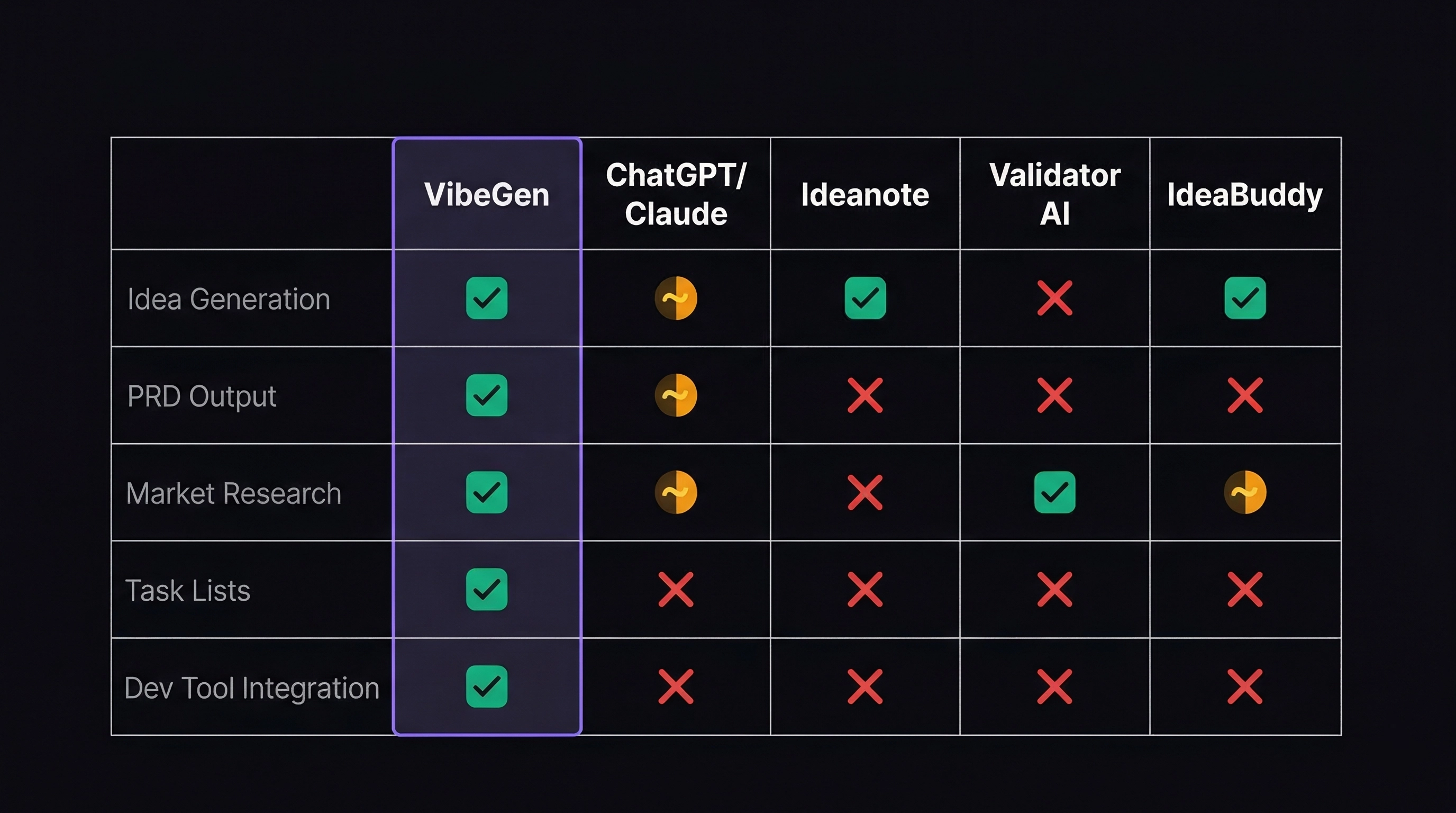
Quick Comparison: AI Idea Generators at a Glance
Before diving into each tool, here's a summary of what matters for vibe coders:
| Tool | Idea Generation | PRD Output | Market Research | Task Lists | Pricing |
|---|---|---|---|---|---|
| VibeGen | Scored & ranked | Full PRD with schemas | Competitor + trend data | Ordered by dependency | Free tier / from €12/mo |
| ChatGPT / Claude | Raw brainstorming | Manual prompting | Manual prompting | Manual prompting | Free tier / $20/mo |
| Ideanote | Team submissions | No | No | No | From $49/mo |
| Validator AI | No (validation only) | No | Basic competitive analysis | No | Free / paid tiers |
| IdeaBuddy | Business-focused | Business plan format | Financial projections | No | From $15/mo |
The key differentiator: most tools stop at idea generation. Only one connects ideas directly to development-ready artifacts — PRDs, task lists, and database schemas that AI coding assistants can consume without translation.
The Top AI Idea Generators in 2026
1. VibeGen — Built for the Vibe Coding Workflow
VibeGen isn't just another idea generator — it's a complete planning pipeline designed specifically for vibe coders and indie hackers.
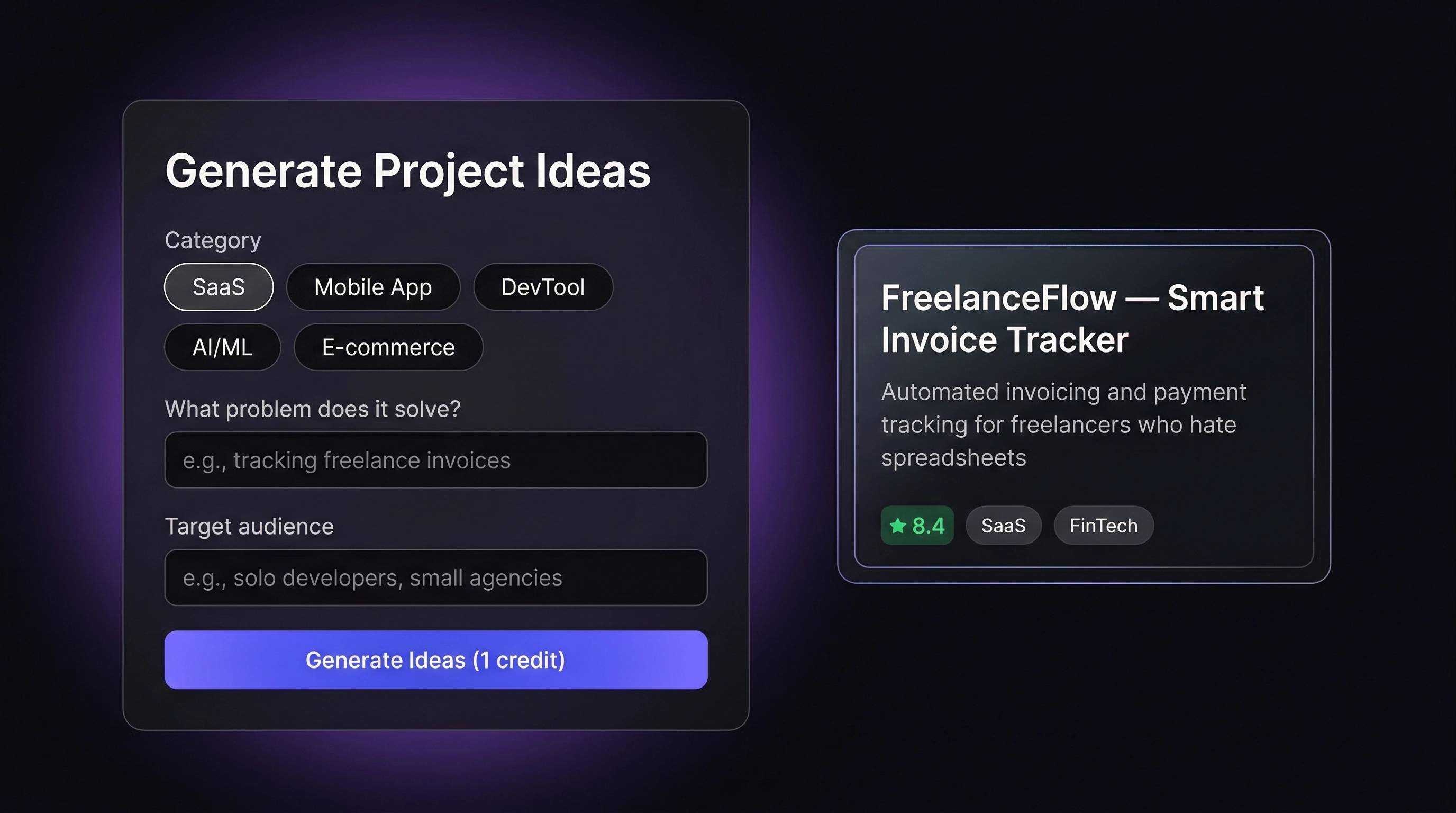
How it works: You describe your skills, interests, and target audience through a guided wizard. The AI generates scored project ideas with market analysis. But here's where it gets interesting — you can then expand any idea into:
- A full PRD with database schemas, API specs, and user flows
- Implementation tasks ordered by dependency (ready to feed into Claude Code)
- Market research with competitor analysis and trend data
- Idea validation scores across viability, complexity, and market fit
Each idea comes with a viability score, complexity estimate, and suggested tech stack. It's like having a product manager and market researcher on speed dial.
In our experience building VibeGen itself, the PRD generation step saved us roughly 4-6 hours of manual planning per project. The structured task output feeds directly into AI coding assistants, cutting the "translate plan to code" gap to near zero.
Pricing: 10 free credits/month. Paid plans from €12/month.
Best for: Indie hackers who want to go from "I should build something" to "here's my project plan" in one sitting.
2. ChatGPT / Claude — The DIY Approach
The most accessible option: just ask a general-purpose AI to brainstorm ideas.
"Give me 5 SaaS ideas for developers who know Python and want to build something in a weekend"
You'll get decent starting points. ChatGPT and Claude are both surprisingly good at this — if you know how to prompt them. The quality ceiling is high, but so is the effort required to reach it.
The catch? You get raw text. No scoring. No market validation. No PRD. No integration with your dev tools. And the output quality varies wildly based on how you frame the request. You're essentially doing all the analysis work yourself — researching competitors, sizing the market, structuring your plan, and formatting it for your coding assistant.
For experienced builders who already know their market and just need a creative push, this works. But for someone trying to validate a SaaS idea rigorously, the manual overhead adds up fast.
Best for: Quick brainstorming when you already have domain expertise and just need a creative spark.
3. Ideanote — Enterprise Innovation Management
Ideanote is a structured platform for teams to collect, organize, and evaluate ideas through collaborative workflows. Team members submit ideas, vote on them, and move winners through evaluation stages.
It's powerful for corporate innovation programs — think hackathon management, employee suggestion boxes, and product roadmap prioritization. The platform shines when you have 10+ people contributing ideas and need a structured process to filter them.
However, it's not AI-native — the platform focuses on human collaboration. AI features are supplementary rather than core. And at $49/month, it's priced for companies with innovation budgets, not solo builders working on side projects.
Best for: Teams managing innovation pipelines, not weekend vibe coding sessions.
4. Validator AI — The Second Opinion
Already have an idea? Validator AI will tell you if it's any good.
You describe your business concept, and it analyzes potential challenges, market fit, and competitive landscape. The output is a structured report with strengths, weaknesses, and recommendations. Think of it as an automated "red team" for your business idea.
It won't generate ideas or produce PRDs and task lists — it's strictly a validation tool. In our experience, it works best as a complement to idea generation rather than a replacement. Generate ideas with one tool, validate the top pick with Validator AI, then move to planning.
The analysis tends to be broad rather than deep. You'll get directional signals (strong market, many competitors, regulatory concerns) but not granular data like specific competitor traffic numbers or keyword difficulty scores.
Best for: Founders who need validation, not ideation. Pairs well with a dedicated idea generator.
5. IdeaBuddy — Traditional Business Planning
IdeaBuddy offers idea generation, business model canvas creation, and financial projections. It walks you through defining your value proposition, revenue model, and go-to-market strategy.
The focus is on business planning rather than software development — no technical artifacts, no coding workflow integration, no database schemas. It's closer to writing a business plan than planning a vibe coding project. The financial projection tools are useful if you need to model unit economics or create investor-ready documents.
If you're a non-technical founder who needs business model clarity before approaching a developer (or an AI coding tool), IdeaBuddy fills that niche. But for indie hackers who want to go from idea to code, there's a gap between IdeaBuddy's output and what your AI assistant needs.
Best for: Non-technical founders focused on business model validation. Starts at $15/month.
What Actually Matters for Vibe Coders
Not all idea generators solve the same problem. Here's what to evaluate:
Integration with Dev Tools
If you're going to vibe code the result, you need structured output — PRDs, task lists, database schemas — that your AI coding assistant can consume directly. Tools that stop at "here's a list of ideas" create a gap you have to fill manually. The time you save on coding gets eaten by planning.
Market Validation
An idea without validation is just a guess. Look for competitor analysis, market sizing, or trend data. According to CB Insights, "no market need" remains the top reason startups fail — 35% of post-mortems cite it. Even rough validation numbers help you avoid building something nobody wants.
Scoring and Prioritization
When you generate 5 ideas, you need to pick one. Objective scoring based on market opportunity, technical complexity, and skill alignment beats gut feeling every time. Without scores, you default to building whatever sounds most exciting — which is often not the most viable option.
Speed
Vibe coding is fast. Your planning tool should be too. If setup takes an hour, it defeats the purpose. The ideal flow: input your context, get scored ideas, expand the best one into a PRD, and start coding — all in under 30 minutes.
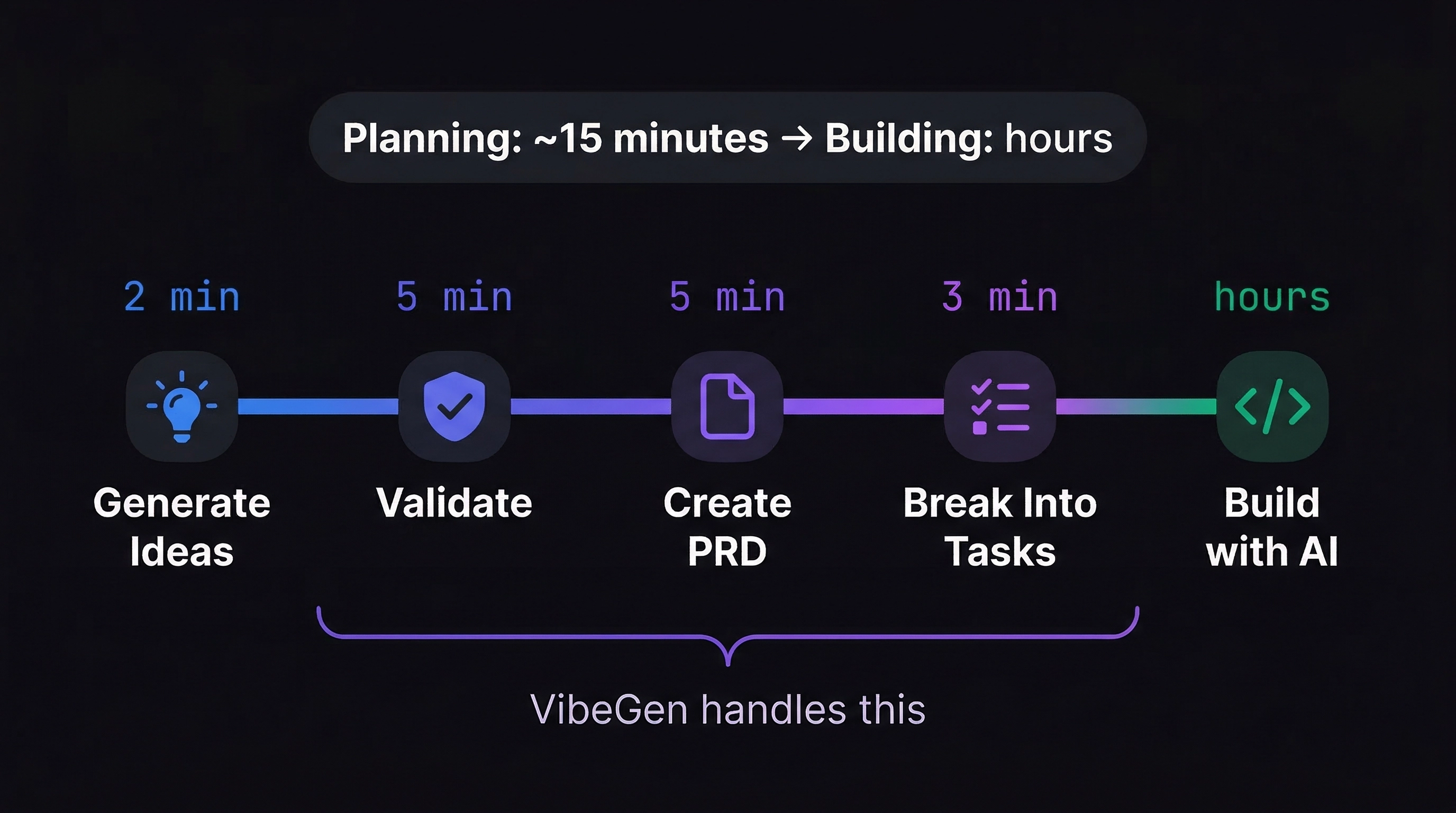
The Vibe Coding Idea Pipeline
The most effective workflow combines idea generation with structured planning:
- Generate ideas — Produce 3-5 scored concepts based on your skills and interests
- Validate the top pick — Check market data, existing competitors, estimated demand
- Create a PRD — Expand into a detailed product requirements document with technical specs
- Break into tasks — Decompose the PRD into ordered implementation tasks
- Choose your stack — Pick the right tools for your project
- Build with AI — Feed tasks into your coding assistant and ship
Tools like VibeGen handle steps 1-4 in a single workflow. You can assemble your own pipeline with ChatGPT + manual research + Google Docs — it just takes significantly longer and produces less structured output for your AI coding assistant.
We built VibeGen using this exact pipeline — the tool planned itself. The first PRD was generated by an early prototype, refined manually, then fed into Claude Code for implementation. The meta nature of that process is what convinced us the approach works.
How to Evaluate Any AI Idea Generator
Before committing to a tool, run this quick test:
- Give it a real problem you have — not a hypothetical. Use your actual skills and interests.
- Check the output specificity — does it give you generic "build a CRM" suggestions, or specific, differentiated concepts?
- Try to act on the output — can you start building from what it gives you, or do you need hours of additional planning?
- Compare against your own research — do its market claims hold up when you check manually?
If the output needs significant rework before it's useful, the tool is adding a step rather than removing one.
Bottom Line
The bottleneck in vibe coding isn't building anymore — it's deciding what to build.
AI idea generators help you skip the guesswork and start with validated, structured project concepts. For indie hackers and vibe coders, the strongest option is a tool that connects idea generation directly to your development workflow — from idea to PRD to task list to code.
The comparison table above should help you pick the right tool for your situation. If you're a solo indie hacker focused on shipping fast, look for tools that produce development-ready output. If you're part of a team or need business model validation, the enterprise-focused options may be a better fit.
Want to try the full pipeline? VibeGen's free tier gives you 10 credits — enough to generate ideas, a PRD, and a task list for your next project.